

The Snow White Fantasy
Just a girl and her boys


Throughout my life, men and I have not gotten along. When I was younger, going through puberty, and as awkward as you can get, I didn’t want to speak to boys at all. I wasn’t shy, I was just cautious. I didn’t want any boys getting the wrong idea, or the right one. If I liked a boy I wouldn’t talk to him, if I didn’t like a boy I wouldn’t talk to him. If they gave any indication of liking me? You guessed it, I wouldn’t talk to them.

I’ve written about my journey to Guy’s Girl Status™ before, and the inevitable disappointment that comes with it. I realized that being friends with men is really no more fun than not being friends with them, there wasn’t much I had missed out on; Irish boys trying to kiss me, Canadian boys calling me manipulative, and American boys making misogynistic jokes I had to laugh off. At first, realizing that there will always be a sexual undercurrent with male friends (and, honestly, with all friends, if you play things the way I do) felt freeing; if there’s always something unspoken then it’s easy to do the spoken part. But, I realized, it’s not sustainable; boys are, for the most part, only tolerant of a friendship with a girl for a while.

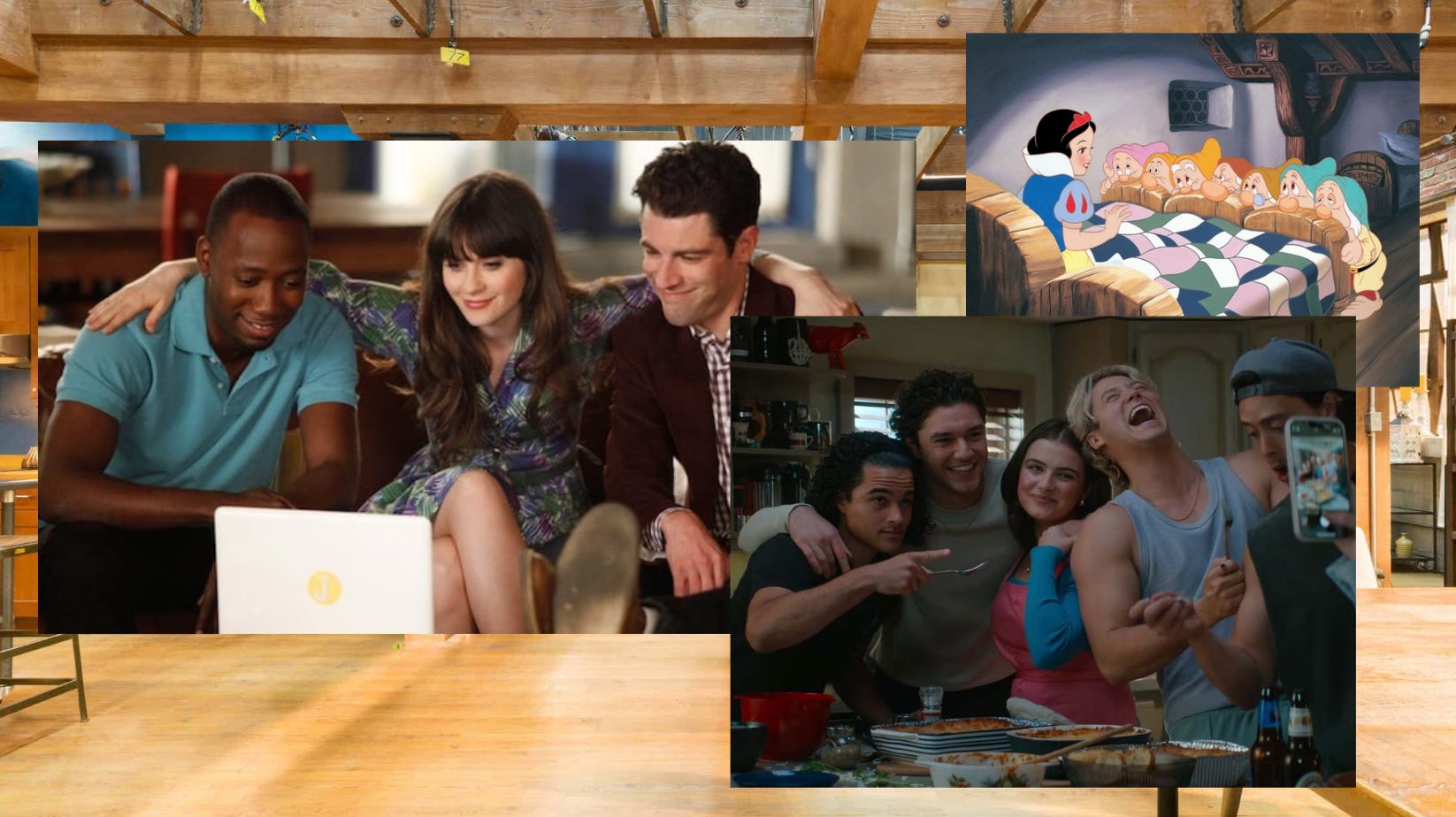
This week, I introduced my housemate to the wonders of my all-time favorite show, New Girl. For the uninitiated, New Girl is the story of a plucky, adorkable (as their heavily-mocked Season One promos phrased it) girl in her early-thirties, whose circumstances bring her to a bright, millennial-perfect loft with three male roommates. There’s Winston, the eccentric goofball, Schmidt, the neurotic horndog, and Nick, the cranky Chicago bartender with a heart of gold.
I love this show. The chemistry is some of the best to appear on television, and I don’t just mean romantic chemistry. The entire cast (Cece and Coach too!) play off each other wonderfully, with an endearing sweetness at the heart of all their crazy shenanigans. Still, starting the show from the beginning is fascinating. The show is a female fantasy, which I don’t mean derogatorily, but also feels like a product of its time. Today, a girl this quirky and tight with guys might be called a pickme; our heroine asks the boys for help dating, sex advice, and accompaniment to various social activities. The early episodes almost always end with the boys rushing to perform some grand, chivalrous gesture for her, one where they prove to her that she deserves the best from men. If the guys she’s dating aren’t going to give her that, her loftmates certainly will. Early reviews were critical of this premise, and the show (although brilliant from its pilot) managed to evolve; during its second season, NPR wrote an article entitled “How ‘New Girl’ Got Smarter, Sexier, And A Lot Less Annoying,” in which they described it as a show that originally “started out seeming like Dumb Snow White And The Three Patient Older Brothers.” Still, throughout its run, New Girl was always a show about men who, despite their flaws, cared deeply for the quirky, lovable meddler living in their house.
The premise reminds me of the recent Amazon Prime success Off-Campus, about a certain Hannah Wells and her fake relationship with Garret Graham, the star hockey player at her college. Garrett lives with his hockey team, and as his relationship with Hannah goes from pretend to definitely not pretend, she becomes friends with his boys. She is sweet and eager to learn from the boys; Garrett and co. teach her about what men like, how to be sexy, etc; in exchange, she becomes a part of their little family. It’s another version of the Snow White fantasy at play in early New Girl; being so dang quirky and cute that (most of) the boys around you are able to really be themselves; putting aside their toxic masculinity in favor of loyalty to a girl they’re not trying to sleep with, but genuinely like and want to take care of. In one scene, Hannah bakes them a big lasagna, then poses victoriously with the boys and the meal she’s made for them.
I don’t mean to undermine the themes of SA and healing on the show; much of Hannah’s journey with the hockey team is about learning to trust men again. But, as with New Girl, there is this pervasive theme of what I think of as the “Snow White fantasy;” if you’re sweet enough and oblivious enough to men’s potential true intentions, you can be the only girl in a house full of boys that will take care of you. Instead of a relationship or sex being the exchange for respect, you need only to be your cutesy, quirky self; one that just so happens to take care of the boys like a (sexy) mother. Or maybe a maid.
I understand the appeal of this fantasy. I’ve struggled for a long time with the feminine need to have men like you, especially just as friends. I think most women know the feeling of disappointment when a man you thought genuinely enjoyed your friendship turns out to be attracted to you. And there is a feeling of safety in the idea that you could have a whole team of sweet but manly guys, ready to jump to your defense at a moment’s notice, making it easier to safely weed out the troublesome potential suitors. The original Snow White story is reliant on traditional gender roles, while entertaining the fantasy that these will ultimately lead women to their happiness. As Cinnamone Winchester puts it in her article ‘Whistle while you work’: “Snow White’s familial dynamics with the dwarfs…may thus be interpreted as an interim and ‘necessary’ relationship with a collective masculine figure until the prince makes his reappearance." By the end of New Girl, the initially chaotic and messy male characters have all settled down and gotten married. Off Campus has only had one season, but it is through Hannah’s role in the boys’ lives that philandering characters meet or set out to meet their first meaningful female partners. This again reflects the Snow White story, as Winchester puts it: “[they] are introduced as rowdy ‘bachelors’ who are ultimately tamed by the domesticity that Snow White brings.”

Feminist discourse has largely moved past the idea that a woman must reject all bastions of femininity in order to be liberated. The titular New Girl herself, in fact, says during a Season 4 episode, “I’m a feminist who loves purses. Where else am I supposed to keep my feminist writings?” She also, during a conversation with Nick’s season one girlfriend Julia, has this iconic speech: “I have touched glitter in the last 24 hours. I spend my entire day talking to children. And that doesn’t mean I’m not smart and tough and strong.” This is all true! I don’t think that New Girl or Off Campus are trying to convince us that domesticity is the only way to succeed as a woman. I do think that both shows play into the fantasy of not only performing femininity but enjoying doing it, and being rewarded with respect from men. It’s difficult to feel valued by male friends, coworkers, or family members, and these shows construct a world in which it is easy and gratifying. It’s a fun fantasy. But it feels like that’s all that it is, imaginary. Made up.
This was great. We have constructed fantasy literary and television worlds around the desire for men to not be creatures of lust but rather of sentimentality, and it is kind of depressing to say the least.
I’ve never thought about New Girl through the Snow White lens before, but the comparison makes the early episodes look completely different. This was an excellent read!!!