

Aren't we all performative?
On Performative Males and whether or not we care

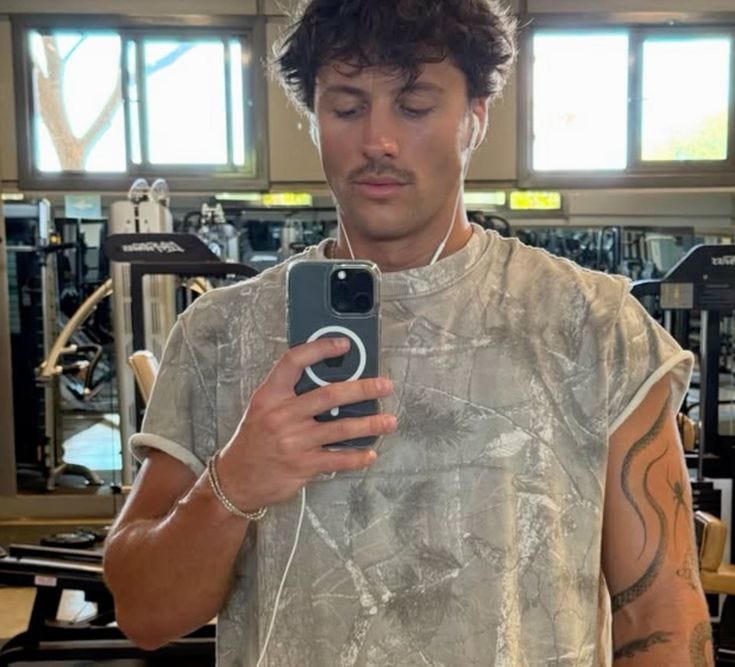
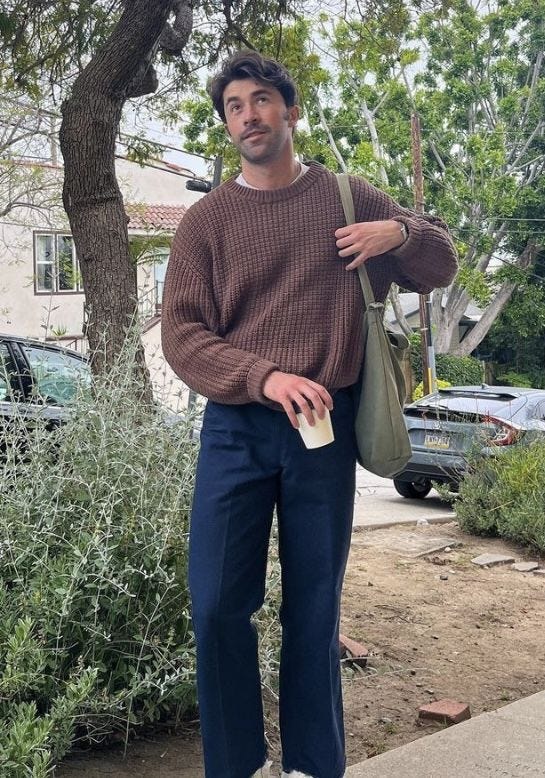
Performative men are this summer’s brats. Or whatever. After several months of sporadic TikToks about the tote bag-toting, Rooney-reading, mustache mavens, making fun of men who wear little outfits is finally an official capital T Trend.
The performative man is a simple collection of diluted traits; ten years ago they were called hipsters, but now they have a fun feminist edge; they listen to lesbian music and drink matcha and have their pronouns written in their email signatures. They go to women’s marches and talk openly about how their girlfriends are out of their league. There is an inherent paradox to the performative man; his performance is rooted in a concept of self-awareness; he knows he’s a man and that he should apologize for that, so he does it often and unsolicited, and then gaslights his girlfriend about her wanting a promotion at work.
The first performative man I ever loathed was a YouTuber that I spent a year thinking was gay. He talked about loving Gaga and Adele and said the character he most related to in all of literature was Connell from Normal People. He wore perfect name-brand outfits and moved in and out of gorgeous European apartments, often referencing off-screen heavy partying, but spending his videos reading in cafes (or rather, filming himself reading in cafes). I started out as a fan, when he lived in his parent’s house and spoke lovingly about books. But as he became more enamored with the character of himself, I became less. When it turned out that he was straight, and I started wondering how he was able to afford all these European houses on a YouTuber’s salary (generational wealth, I would assume), I knew it was time to head out.
I grew up in a fashionable city with kids that did coke and wore vintage Vuitton. I remember the day everyone started typing without capital letters, because I felt like I had missed the memo. The thing was, I thought, you had to go into your Settings to turn off auto-capitalization. But the whole concept of not capitalizing things, as I understood it, was to seem so nonchalant you don’t even care to use proper grammar. But if you took the time to decide to be nonchalant, then opened up Settings and solidified it, wasn’t that far more purposeful than just typing normally?
In college, the cool girls all dressed the same and talked the same and posted on Instagram in the same way. I wondered where they had all learned to be cool. So much of it felt like it was for attention from the skater boys who were too chilled out to join a frat. The girls would stand around and smoke cigarettes, gazing anywhere but at the boys they were there for. It just seems like so much work, I thought. So much work to be not like everyone else, just like everyone else. They’re picking out their clothes at vintage stores, but they’re all wearing the same thing. They’re all dyeing their hair the same two-toned black and bleach. It didn’t seem cool or nonchalant to me, it just seemed exhausting.
And the boys. Ugh. They all wore those big Carhartt jackets and squinted when they half-smiled. They smoked weed in their shitty college apartments and went home to their parents’ cushy suburban three-bedrooms on the weekend to do laundry. It was performative, that is the perfect word. I often thought about these cool stoners as children, shouting at each other on the playground and asking innocuous questions. And yet, in classes, I still wanted them to think I was cool. Or at the very least, not think about me at all.
Being in my twenties, I’ve been so delighted to finally feel like the character of myself that I’ve always wanted. When I was a moody tween, I had a concept of myself as a social, joke-making party girl. And now, well, here I am. It always feels nice to have been right about yourself. But still, I feel like I’m performing. Sometimes I’m okay with that, because the performing feels like a shortcut to being myself. But sometimes I go into a social situation exhausted, determined not to play the part of Me, and then I get there and all I want to do is tell a humorous, self-deprecating story and buy everyone a drink. I am far from a Performative Man, and you would never call me cool or nonchalant, but I have curated a version of myself that makes me happy but is, at least somewhat, rooted in performance. Wasn’t it Miss Piggy who said we’re born naked and the rest is just drag?*
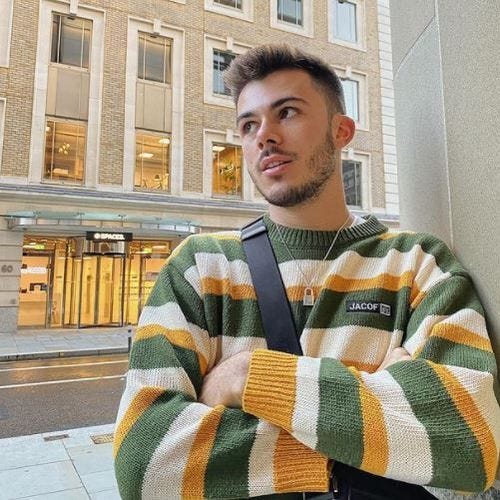
I think an important part of the performative male conversation is that the things they’re doing are normally associated with femininity. Does that make them performative, or is that inherent to the things themselves? I am firmly in the camp that gender is always a performance, and femininity in particular is a carefully-constructed artifice; ever-evolving and yet always, however indirectly, built to serve the patriarchy. There is this feeling of ownership when men start listening to our music and drinking our drinks. But how much of those things are really “ours”?
The other thing, which I think is the real point of all the discourse, is the untrustworthiness of these men. And really all men, I guess. After finally leaving her relationship with her abusive boyfriend, a college friend of mine started dating a new guy from work. He was a bisexual artist, he had traveled the world and he had exclusively female friends, one being his sister. He spoke openly about being uncertain of his gender as a child, he embroidered flowers on his jeans. He remembered what kind of M&Ms she likes best and brought them to their second date, a picnic on a log in a nature preserve. Three separate women had accused him of SA. The reason he had all female friends was because they were all new friends, everyone that knew him before had cut him off. He cried when she confronted him, saying he was misunderstood and that things had been really hard for him — he had even been turned away at parties! He worried that his “rumor” would keep him from opening a Montessori school to serve the local community. She stayed with him. We’re not friends anymore.
This week, during the dissolving of a friendship I’d had with a straight boy, I felt the same sense of unsurprised disappointment I had felt then. He was a “male feminist”, a guy who would describe himself as a Nice Guy if we hadn’t already decided that was a cringey thing to do. A guy who complained about being in the friendzone but knew “how stupid that sounds”. He wielded self-awareness to keep himself afloat in a sea of smart female friends. And then, when things didn’t go his way, he called me and yelled at me for an hour. All the showmanship and valor he had so carefully curated faded as he called me an obsessed manipulator. He felt entitled to apologies on apologies, and was furious at me for not giving him the validation he wanted. This same boy once stood between me and a gropey guy in a club. Does that mean there’s nuance to all this? Does that mean men can be two things?
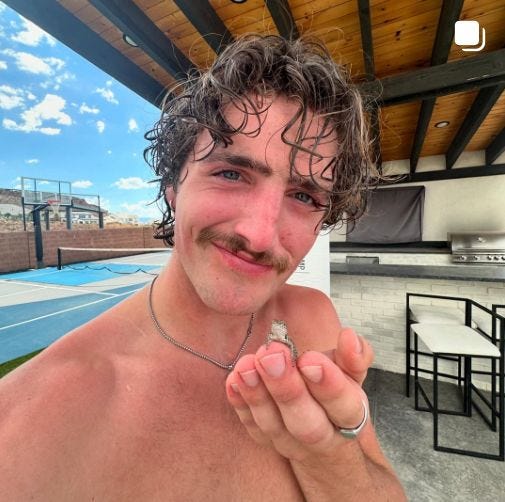
I think sometimes the performance does benefit us. At least some of these boys are reading things by women! At least if they’re pretending to love giving head, other boys will think it’s cool and do the same? Is it better than the hypermasculine homophobia of the 2000s? I really don’t know. I think it isn’t possible to exist without performance, though. Even now, the men making fun of the performative males are doing it to distinguish themselves, to seem smarter and more self-aware and genuinely on the girls’ side. And yet, we’re all on the internet, diluting ourselves to create characters that make fun of other characters. That’s how it’s always been, in some way or another. Also, I do like the mustaches.
*I’m joking, I know it’s Ru Paul.
The idea of self-awareness as a kind of shield and the way performance gets weaponised to gain trust is so real. Your point about everyone becoming characters online to mock other characters feels spot on - it feels like we’re all just cosplaying authenticity! But also yeah fully agree… the moustaches can stay
I'm almost 50 and those men have always been around. They even showed up in Women's Studies classes and of course they spoke over everyone.